FIRST LIGHT. THEN NUMBERS.
What is colour? From light to perception.
Change the light without changing the material. See why Kelvin or RGB alone cannot describe colour.
Read the numbers. Notice the assumptions. Then apply the idea to your footage.
Light × material
Synthetic spectra, not a real lamp or D65. Opaque, non-fluorescent material; fixed geometry. Energy fraction is not luminance or a prediction of perceived colour.
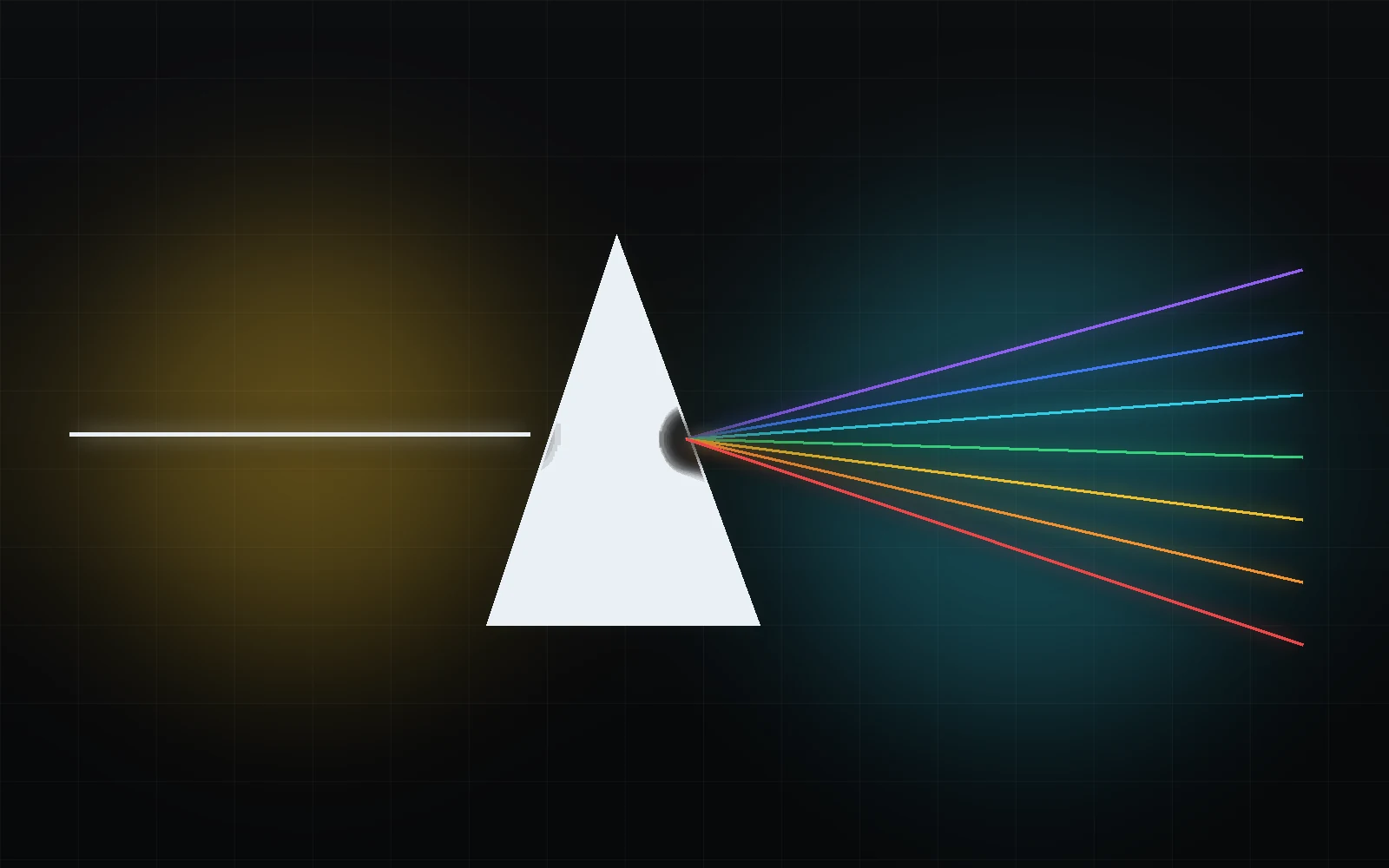 TOPIC ILLUSTRATION
THE ESSENTIAL IDEA
What is colour
Colour is not stored inside an object as a ready-made property. A light source illuminates a material, the material reshapes the spectrum, the eye and brain interpret the result, and cameras and displays only build technical models of that process.
- Separate spectrum and RGB
- Test light with the material
- Do not expect a LUT to restore a spectrum
First there is electromagnetic radiation, not colour
Physically, a source emits energy across wavelengths. Human vision responds only to a small region we call visible light. It is more useful to think in terms of spectral power distribution, or SPD, than a single number describing the 'colour of a lamp'. Two sources with similar correlated colour temperature can have very different SPDs and can render materials and cameras differently.
What this means in practice
An RGB file no longer lists energy at each wavelength. Comparing lamps with one frame or three eyedropper values cannot reconstruct their spectra. For a shoot, testing the actual material under the actual light is more useful than treating equal Kelvin settings as a guarantee.
Wavelength helps describe light but is not the same as perceived colour
Monochromatic light can be associated with one wavelength, but most real colours are produced by mixtures of many wavelengths. Purple colours do not correspond to a single spectral wavelength at all; they arise from combinations of long- and short-wavelength energy. That is why the simple formula 'colour equals wavelength' is too crude for colour science.
What this means in practice
A laser line is a useful near-narrowband example; a daylight-lit white wall returns a broad mixture. A software hue wheel includes purples, so it is not a wavelength ruler bent into a circle.
Illuminant: the light falling on the scene
A source is a physical lamp or emitter. An illuminant describes a lighting spectrum, including a standardised one. A white point reduces that description to a reference chromaticity; it no longer contains the whole spectrum. D65 can denote a standard daylight illuminant, while in an RGB specification it usually identifies the corresponding white point. A lamp labelled “6500 K” need not reproduce the D65 spectrum.
What this means in practice
Separate “what illuminated the object?” from “what white is assumed by the encoding?”. Choosing D65 for a working representation answers the latter and does not identify the fixture used on set.
A material changes the spectrum — within a model’s limits
For a simple opaque, non-fluorescent surface, the reflected spectrum is proportional to illumination E(λ) multiplied by reflectance ρ(λ), with geometry accounted for. This is a useful starting model, not a complete law for all materials: transmission, specular reflection, fluorescence and emission require additional descriptions. Saying that a material “only filters light” without qualifications is therefore misleading.
What this means in practice
The lab slider moves a model reflectance band. Raising saturation cannot restore a missing part of the incident spectrum: that energy was absent. The displayed reflected-energy fraction is not weighted by visual sensitivity and is not luminance in nits.
Colour emerges on the observer side
After light interacts with a material, a spectrum reaches the eye and the visual system converts it into a small set of receptor responses. The brain also uses surround, adaptation and relative brightness and colour relationships. In a strict sense, colour is therefore not just a physical spectrum but a perception produced for an observer under defined conditions.
What this means in practice
Distinguish a signal change from a change of appearance. Altering the surround can change your judgement without editing a pixel. The next chapter lets you test this with two numerically identical patches.
Why different spectra can look the same
If two different spectral distributions produce sufficiently similar tristimulus responses, an observer may perceive them as the same colour. These matches are called metamers. Colour reproduction fundamentally relies on this: a display does not reproduce the spectrum of a real object, but its RGB mixture can trigger a similar visual response.
What this means in practice
Two fabrics can match in daylight and diverge under another source. White balance can align a neutral without ensuring that every material matches. Three RGB coordinates cannot uniquely recover the original spectral distribution.
A camera does not see the scene like the eye
A sensor measures light through its spectral sensitivities and filters. RAW stores sensor data together with supporting metadata; it is not the same as a finished RGB image encoded with a log curve. Decoding and processing establish the chosen colour representation. Two cameras may render a fabric or LED source differently even with matching white-balance settings.
What this means in practice
Begin camera matching with correct decoding and input transforms, then compare real objects. One global temperature slider cannot represent every spectral-sensitivity difference. Metadata helps interpret a measurement; it is not the measurement itself.
A display does not recreate the scene spectrum
A display mixes its own red, green and blue primaries. Their spectra are normally very different from those of the original object, but a correct colour pipeline makes them produce the required CIE tristimulus values and a convincing visual match. This is where RGB primaries, white point, gamut, transfer functions and colour spaces enter the story.
What this means in practice
A display emits its own light mixture, not a miniature copy of the set lighting. A convincing match requires a controlled colour chain and viewing conditions. Similar appearance on two displays does not demonstrate identical physical spectra.
A minimal model of the whole colour chain
For post-production, keep one chain in mind: illuminant → spectral scene → camera response → encoded signal → working colour space → creative grade → output transform → display emission → observer. An error at any stage may look like 'wrong colour' even though the underlying cause is completely different.
What this means in practice
Write out the chain: light and material → camera data → interpretation → grading → target display. Do not conceal an input mistake with an arbitrary LUT. First find the stage where the signal’s meaning became wrong; then make creative decisions.
A MODEL YOU CAN CHECK
Do not confuse a description with a measurement
Keep the meaning, the calculation and the limitation together.
S(λ) ∝ E(λ) · ρ(λ)E is illumination; ρ reflectance; S the reflected spectrum. Geometry is fixed, with no emission or fluorescence.
| Concept | What it describes | What not to conclude |
|---|---|---|
| Spectrum / SPD | Energy distributed across wavelengths. | Not uniquely recoverable from RGB. |
| White point | Reference neutral chromaticity. | Not a source’s full spectrum. |
| RGB | Three coordinates in a specified representation. | Not a lighting recipe or a fabric property. |
| Perceived colour | The appearance under defined conditions. | Not determined by file codes alone. |
DO. OBSERVE. EXPLAIN.
One material. Three descriptions of light.
Start with this page’s lab. For an on-set check, use a stationary object and fixed camera settings; do not compare captures with changing automatic settings.
- 01
Select the broad source
Keep the reflectance centre near 610 nm. Inspect input and output curves separately.
CHECKOutput does not exceed input where ρ is between 0 and 1.
- 02
Switch the source
Compare the long-wave and short-wave models without changing the material.
CHECKEρ changes even though ρ stays fixed.
- 03
Change the material
Move the reflectance band, then select neutral reflectance.
CHECKFor the neutral sample, the output shape follows the input.
- 04
State the limitation
Explain why the graph neither measures your lamp nor predicts the final fabric appearance.
CHECKYou distinguish a teaching spectrum model from colourimetric prediction.
Check your understanding
TEST THE EXPLANATION
A situation, not a trick question.
Answer first. Open the reasoning afterwards.
01Both lamps say 5600 K, but the fabric differs. What next?+
Equal CCT does not guarantee equal spectra. Check the material under each source, camera settings and the input transform. White balance alone cannot establish identical illumination.
02Why does adding red not restore the original colour?+
A global RGB adjustment changes measured coordinates. It does not know which spectral contribution was absent or how different materials responded. Sometimes the capture conditions, not the grade, need changing.
03Can a HEX value reveal the spectrum?+
No: many spectra can match in three coordinates. A CSS HEX value specifies an sRGB colour, not an object or display spectrum.
Avoid these shortcuts
- Assuming an object has one absolute 'true RGB' value.
- Reducing every colour to one wavelength.
- Treating colour temperature as a complete description of a source spectrum.
- Expecting a camera and the human eye to have identical spectral sensitivity.
From the model to your workflow.
When Resolve shows Rec.709, LogC4, D65 or CST, these are not unrelated magic settings. They describe different stages of one chain: how the camera represented the scene, the space you work in and how the result should become light on a particular display.
CHECK THE FOUNDATION
Sources and model limits.
Editorial review: 30 September 2026. Links identify the definitions and formulas; exercises are independent teaching examples.
- [1]CIE · Perceived colour ↗
Perceived colour and the role of viewing context.
- [2]CIE · 1931 Standard Observer ↗
Standard colour-matching functions, not cone sensitivities.
- [7]W3C · CSS Color 4 ↗
Definitions and numerical conversions. Candidate Recommendation Draft, 26 September 2026, not a final Recommendation.
- [10]Blackmagic Design · Color ↗
The practical connection to colour management and Resolve tools.