FIRST LIGHT. THEN NUMBERS.
How we see colour. Context changes appearance.
Two patches receive identical numbers. Only the surround changes. Compare what you see with what is actually encoded.
Read the numbers. Notice the assumptions. Then apply the idea to your footage.
Same code. Different context.
A = 128, 128, 128B = 128, 128, 128The centre codes are identical. Appearance depends on the observer and display. A context demonstration, not a colour-vision test or monitor calibration.
 TOPIC ILLUSTRATION
THE ESSENTIAL IDEA
How humans see colour
The eye does not record a spectrum like a laboratory instrument. It converts light into a limited number of receptor signals and the brain compares them with each other and with the surround. The same physical stimulus can therefore be perceived differently under different conditions.
- Distinguish code from appearance
- Separate RGB, LMS and XYZ
- Compare within a stable surround
The retina: rods and cones do different jobs
Rods are especially sensitive in dim conditions; cones underpin ordinary daylight colour vision. Between these conditions lies a mesopic range in which both systems contribute. There is no simple “rods at night, cones by day” switch. Evaluating video on a display normally assumes controlled viewing conditions, rather than complete darkness or arbitrary bright light around the display.
What this means in practice
Darkening the room and abruptly raising screen brightness changes viewing conditions, not file data. It is not a way to reveal a “true colour”. Keep brightness and surround stable when comparing versions.
S, M and L are not simply 'blue, green and red'
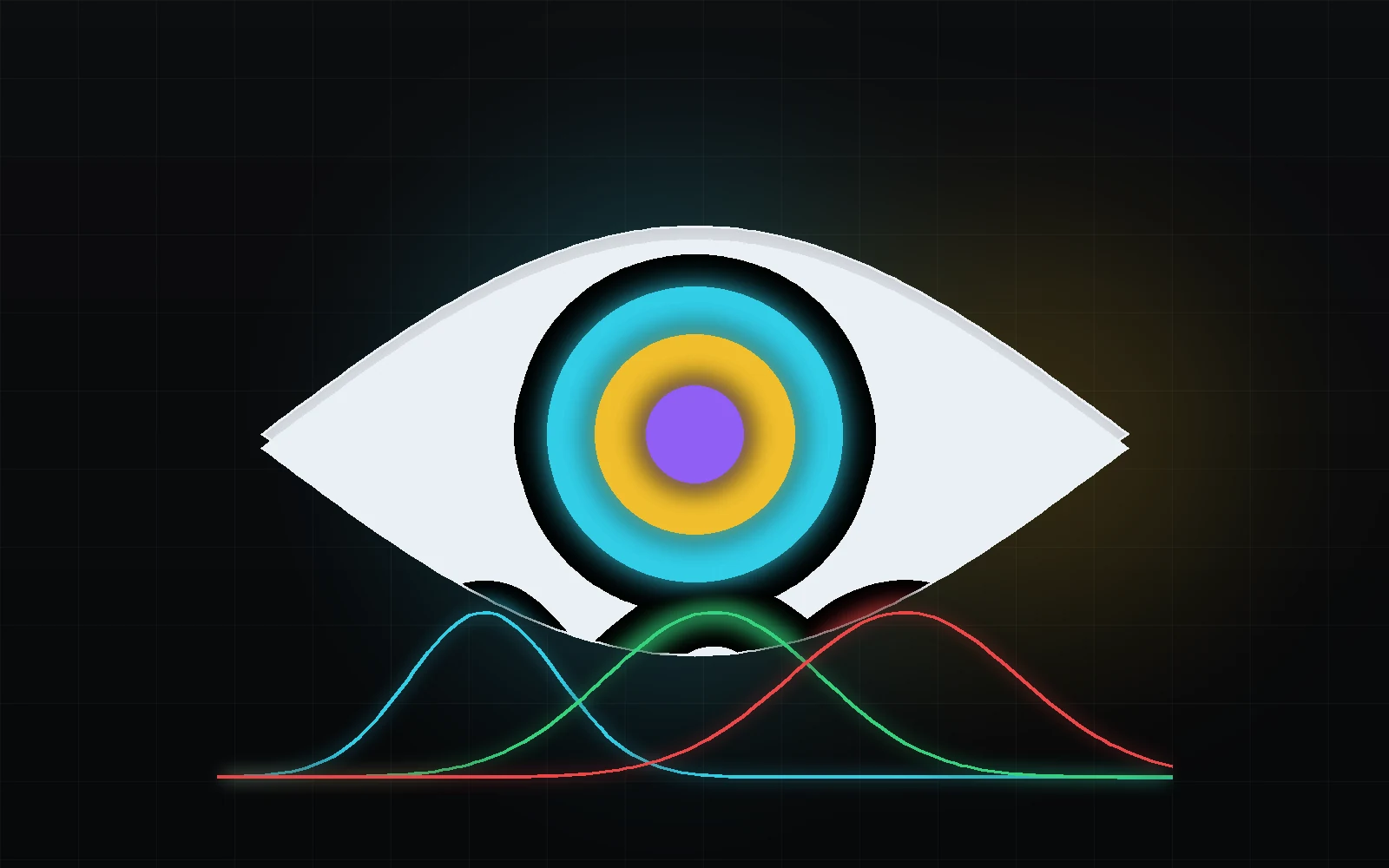
The three cone classes have overlapping spectral sensitivity curves. S cones are biased toward shorter wavelengths, M toward medium wavelengths and L toward longer wavelengths, but each class responds across a broad range. Renaming S/M/L literally as B/G/R is therefore misleading.
What this means in practice
A single receptor does not uniquely report wavelength: weaker light where it is more sensitive and stronger light where it is less sensitive can give similar responses. Discrimination depends on relationships, not three independent spectrometers in the eye.
Trichromacy and the idea of three coordinates
For a large class of colour stimuli, visual matching can be represented using three independent quantities. This makes tristimulus colorimetry, RGB systems and CIE XYZ possible. Importantly, mathematical tristimulus coordinates are a perceptual matching model, not direct readings from the three cone classes.
What this means in practice
Do not apply the model literally to every person. Colour-vision variations and observer differences exist. Three standard coordinates support reproducible colour matching, not a claim that everyone sees every frame identically.
Metamerism: the foundation of colour reproduction
Different spectra can match in tristimulus values for a selected observer. This lets a display reproduce a colour without copying the scene’s spectrum. For reflecting samples, changing the illumination changes the outgoing spectra themselves, so a match may disappear. Observer differences also matter for emissive displays. Metamerism does not mean that any two identical RGB files are a pair of different physical spectra.
What this means in practice
The fabric example concerns a changed reflected spectrum. Two displays may instead differ in their primary spectra and in observer response. These are different tests, not a single diagnosis that every display has the wrong profile.
After the receptors, the brain is not simply three independent RGB channels
Neural processing builds opponent and luminance relationships: roughly red–green, blue–yellow and light–dark components. Perceptual hue, brightness and colourfulness therefore cannot be read directly from three cone responses. This is one reason perceptual colour models are more complex than plain RGB.
What this means in practice
Perceptual red–green opposition does not mean that subtracting file channels gives an exact neural model. RGB, LMS and perceptual coordinates describe different things. Similar names do not make their formulas interchangeable.
Chromatic adaptation: the brain continuously redefines neutral
Vision partially adapts to illumination; a familiar white sheet can retain a white appearance in different conditions. Colour constancy is not absolute, and the outcome depends on the surround and the observer’s task. A chromatic-adaptation transform, for example between reference whites, models a limited part of this behaviour. It does not “reprogram the brain” or repair every lighting error.
What this means in practice
Compare a new version with a saved reference, not only your memory of a minute ago. Becoming used to a cast does not establish technical correctness. The surround experiment illustrates context; it does not measure your adaptation.
The surround changes perceived brightness and colour
The same image patch can appear lighter, darker, warmer or cooler depending on neighbouring regions and overall adaptation. A reference monitor alone therefore does not solve the whole problem; the viewing environment is part of the image-evaluation system.
What this means in practice
The lab changes the backgrounds while assigning identical CSS RGB to the central patches. A shared-surround button removes that context difference. The effect can be stronger or weaker on your screen; numerical equality is checked independently of appearance.
Why CIE needed a Standard Observer
Real people differ slightly in colour sensitivity. To make measurements reproducible, the CIE standardised colour-matching functions. The CIE 1931 2° Standard Colorimetric Observer is used for smaller visual fields, while the supplementary CIE 1964 10° observer represents larger fields. This is not a 'perfect human'; it is an agreed measurement model.
What this means in practice
The x̄, ȳ and z̄ functions describe experimental colour matches in a standard model. They are not the three S/M/L cone sensitivity curves. The 2° and 10° fields refer to angular viewing size, not image resolution.
What this means for a colourist
Scopes provide objective information about the signal, while vision judges the perceptual result. But eyes adapt, fatigue and depend on the surround. Serious grading therefore combines a calibrated display, controlled viewing environment, scopes, reference images and regular breaks rather than relying on any one of them alone.
What this means in practice
When a client sees a different cast, first compare file, application, profile and surround. Do not infer someone’s visual abilities from a disputed frame. A verified technical chain and a shared reference are more useful than eye-matching every arbitrary display.
A MODEL YOU CAN CHECK
Four levels that should stay distinct
Keep the meaning, the calculation and the limitation together.
RGB(A) = RGB(B) ≠ a guarantee of identical appearanceEquality is built into the patch codes. This is not a vision test or display calibration and does not promise identical effect strength for everyone.
| Concept | What it describes | What not to conclude |
|---|---|---|
| S / M / L | Cone classes with broad sensitivities. | Not literal B/G/R file channels. |
| CIE XYZ | A standard tristimulus representation. | Not a direct readout of a person’s cones. |
| File RGB | Coordinates in a particular representation. | Not a complete appearance model. |
| Surround | Part of the viewing conditions. | Not an edit to the file itself. |
DO. OBSERVE. EXPLAIN.
Check equality. Then appearance.
Keep screen brightness stable during the experiment. The result is subjective: seeing little illusion does not indicate a vision problem or a failed test.
- 01
Compare the centres
Keep patch code 128 with different neutral surrounds. Look at the centres rather than the borders.
CHECKBoth centre codes remain 128 / 128 / 128.
- 02
Remove the context
Select a shared surround without changing the patch slider.
CHECKBackgrounds change, not the central patch data.
- 03
Change the surround
Compare neutral and coloured surrounds. Do not record a subjective difference as a measured ΔE error.
CHECKYou separate appearance from signal measurement.
- 04
Apply the principle
Compare two versions of your frame on the same surround and against a saved reference.
CHECKYou do not replace a reference with memory of the previous image.
Check your understanding
TEST THE EXPLANATION
A situation, not a trick question.
Answer first. Open the reasoning afterwards.
01Identical patches look different. Is it a bug?+
Numerical equality and perceived equality are different checks. A shared surround makes the contexts similar. Your display also affects physical output, so this is not a device measurement.
02The scopes look fine. Is the colour correct?+
Scopes describe signal properties; they do not decide creative intent or fully account for surround. A controlled view, reference and defined target are still needed.
03Why is this not a colour-vision test?+
The patches are not a standardised diagnostic procedure. Display characteristics, illumination and viewing conditions are uncontrolled. The experiment explores context, not a person’s condition.
Avoid these shortcuts
- Treating cones as literal R/G/B sensors.
- Treating the Standard Observer as an exact model of every person.
- Ignoring surround and adaptation.
- Trusting only your eyes or only scopes.
From the model to your workflow.
When an image 'suddenly looks normal' after ten minutes, that does not necessarily mean you fixed it — your visual system may have adapted to it. This is why reference viewing and scopes matter.
CHECK THE FOUNDATION
Sources and model limits.
Editorial review: 30 September 2026. Links identify the definitions and formulas; exercises are independent teaching examples.
- [1]CIE · Perceived colour ↗
Perceived colour and the role of viewing context.
- [2]CIE · 1931 Standard Observer ↗
Standard colour-matching functions, not cone sensitivities.
- [3]Stockman & Sharpe · Vision Research, 2000 ↗
Primary measurements of M- and L-cone spectral sensitivities.
- [4]Ekroll · Simultaneous colour contrast, 2005 ↗
Research into surround effects on perceived colour.
- [10]Blackmagic Design · Color ↗
The practical connection to colour management and Resolve tools.