KNOWLEDGE MAP · SDR & HDR
One signal. Different display conditions.
Change signal, reference-display peak and black. Inspect the OETF, luminance-coupled OOTF and the error of independent channel gamma.
Read the numbers. Notice the assumptions. Then apply the idea to your footage.
Same signal. Different light.
1.2203.152 nit203.152 nitInspect RGB calculations
R′G′B′: 0.75 / 0.75 / 0.75
RGB scene: 0.26496 / 0.26496 / 0.26496
RGB display: 203.15215 / 203.15215 / 203.15215
Wrong RGB: 264.96256 / 264.96256 / 264.96256
β = 0
BT.2100 HLG: inverse OETF → luminance-coupled OOTF; black lift included. Peak is limited to the 400–2000 cd/m² range of the displayed gamma formula. The dashed comparison is an intentional processing error. Numbers are calculations, not screen measurements.
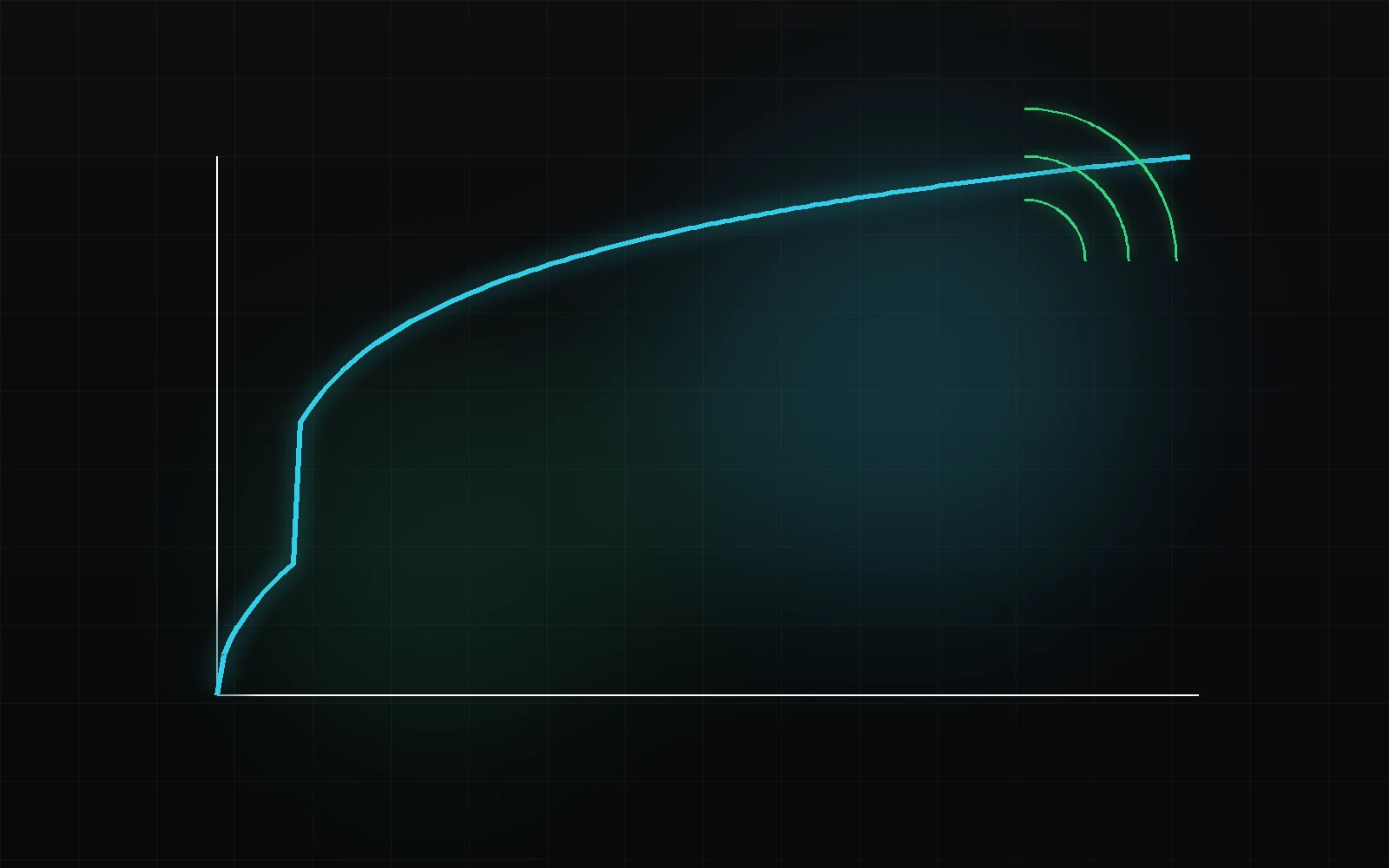 TOPIC ILLUSTRATION
THE ESSENTIAL IDEA
HLG: relative signal and display system
HLG combines relative scene encoding with a coordinated display system. Luminance depends on display assumptions as well as code. Decoding the hybrid curve alone does not produce the final display light.
- Separate OETF, inverse OETF and OOTF.
- Explain when 75% HLG yields approximately 203 cd/m².
- Avoid replacing the shared luminance function with per-channel gamma.
HLG is more than an HDR label
HLG was designed with television production and relative signal transmission in mind. It combines encoding and display behaviour rather than merely changing a file label. Receiver support and a coherent chain remain necessary.
Start with relative scene light E, nonlinear signal E′ and display light. The OETF connects the first two; final display behaviour also includes an OOTF. Omitting that stage gives a different tonal response.
What this means in practice
Select the “No OOTF” comparison. The curve difference comes from a missing operation, not from a gamut change.
Two branches of one function
The lower HLG OETF branch is √(3E); the upper branch is logarithmic. They meet at E=1/12 and E′=0.5. Direction matters: decoding signal back to relative light uses the inverse expressions.
The lab applies the inverse OETF before forming display light. Its curves and values belong to this chain. At zero display black, zero code yields zero, and maximum neutral code reaches the selected reference peak.
What this means in practice
Set the signal to 0.5: neutral light before the OOTF is 1/12, not 50% of display light.
Why one power function cannot replace HLG
The Hybrid Log-Gamma name does not mean “apply 1/2.2 everywhere”. A power approximation may match some points while deviating in shadows or highlights; the error then propagates through display rendering.
The hybrid OETF and system gamma serve different purposes. One encodes relative light; the other participates in scene-to-display rendering. The lab uses the defined piecewise function and its analytic inverse, not a CSS approximation.
What this means in practice
Check the join and highlights separately. Matching one grey patch does not validate an entire transfer function.
The same code at a different peak
HLG relative encoding does not assign one unique cd/m² value to every code without display assumptions. Changing peak in the lab keeps code fixed while changing system gamma and display light. This is intentional, not quantisation error.
“Relative” does not mean arbitrary playback. BT.2100 defines a reference system and adjustment rules. The lab restricts peak to 400…2000 cd/m², the domain of the simple formula used here, rather than extrapolating it.
What this means in practice
Hold N at 0.75 and compare peaks of 400, 1000 and 2000. Record N, γ and luminance together.
The OOTF uses shared RGB luminance
The reference HLG OOTF derives one multiplier from scene luminance Ys and applies it to all three components. For a neutral, this simplifies to a power relationship; raising coloured R, G and B independently to γ gives a different colour.
BT.2100 also specifies black-level adjustment through β. The lab exposes this effect explicitly. Surrounding conditions remain reference assumptions: this is not a simulation of visual adaptation or a particular television.
What this means in practice
Choose the warm sample and “Per-channel gamma”, then neutral. Neutral hides this implementation error, so a grey ramp alone is insufficient.
When 75% means approximately 203 cd/m²
With a 1000 cd/m² reference peak, system gamma 1.2 and zero black, neutral code 0.75 yields approximately 203 cd/m². These assumptions explain the production anchor; they do not make that code equally bright on every screen.
The lab reports the 75% neutral reference separately from the current coloured sample. Changing to blue does not redefine blue-pixel luminance as white. Update expectations when peak or black changes.
What this means in practice
Reset, then select blue. The “75% neutral” reference retains its meaning while the current sample’s luminance changes.
Separate transfer function from colourimetry
BT.2100 needs primaries, white point and component representation as well as HLG. The lab’s Ys weights belong to linear BT.2020 RGB; do not reuse them for an arbitrary RGB basis.
Y′CbCr input requires the correct matrix and normalisation. Treating luma alone as a neutral step is not equivalent to reconstructing a coloured RGB pixel. At export, verify transfer, primaries and matrix coefficients together.
What this means in practice
BT.2020 HLG and BT.2020 PQ share primaries, not encoding. One matching tag does not make the files interchangeable.
No required mastering metadata does not mean no rules
The HLG reference system does not require a mastering-display description for each programme, which suits a consistent television chain. Receivers must still recognise HLG and the stream’s agreed parameters. Image appearance alone cannot reliably signal HDR.
Live production particularly needs stable reference levels and predictable input handling. Switching among cameras, graphics and SDR archive should not introduce brightness jumps through interpretation errors. This is a production-wide technical and operational task.
What this means in practice
Test camera-to-title-to-SDR transitions, not just one correctly displayed HLG frame.
Compatibility does not replace SDR review
HLG was designed with some viewing compatibility in mind, not identical results on every SDR device. Colourimetry, receiver mode, levels and contrast matter. Arbitrary playback of BT.2020 HLG as Rec.709 SDR can alter both tone and colour.
For an SDR master, perform a defined conversion and review it separately. A tolerable fallback is not an authored SDR deliverable. BT.2446 describes HDR/SDR conversion approaches with different trade-offs.
What this means in practice
Compare SDR fallback playback with a controlled SDR export. Similar brightness does not prove matching colour or highlights.
Importing graphics and finished footage
SDR graphics codes cannot simply be interpreted as HLG. Identify their space, decode appropriately and place them into the target system. Finished PQ also has its own rendering and needs a coordinated conversion.
Decide where compositing occurs relative to output processing. Linear-light blending differs from code-value blending, and alpha handling must agree. Title white should follow intent and production references rather than an accidental channel maximum.
What this means in practice
Correctly imported sRGB white need not become HLG code 1. Define its graphics-white role first.
An HLG scope needs interpretation assumptions
HLG signal percentage and cd/m² are different scales. If a scope reports luminance, establish its reference peak, black and system assumptions. Coloured signals also require the correct RGB-to-luminance relationship.
Compare a known neutral step and coloured samples. Together they help separate OOTF mismatch from matrix errors. Software values alone cannot measure the actual monitor or perceived brightness.
What this means in practice
Check neutral at 0%, 50%, 75% and 100%; then inspect all three reconstructed components for the warm sample.
Avoid applying HLG conversion twice
In Resolve, distinguish finished HLG input from scene-referred footage awaiting HLG output. Input assignment describes existing samples; output conversion forms a target representation. They are not interchangeable.
Inspect project management, explicit CSTs and monitoring. Record reference assumptions when comparing HLG with PQ. Unmatched viewing systems can explain differences without implying an incorrect source curve.
What this means in practice
Export a short test and reimport with the correct explicit input. Ensure the finished image does not receive the same rendering twice.
A MODEL YOU CAN CHECK
Three stages that must remain distinct
Keep the meaning, the calculation and the limitation together.
E′ = √(3E), E ≤ 1/12; E′ = a ln(12E − b) + c, E > 1/12a=0.17883277; b=1−4a; c=0.5−a ln(4a). At reference black 0: Dᵢ=Lw·Ys^(γ−1)·Eᵢ, Ys=0.2627R+0.6780G+0.0593B. The lab uses γ=1.2+0.42log₁₀(Lw/1000) only for 400…2000 cd/m², with BT.2100 β adjustment for nonzero black.
| Concept | What it describes | What not to conclude |
|---|---|---|
| OETF | Relative light to nonlinear signal. | That it alone defines final screen luminance. |
| Inverse OETF | Signal to relative linear light. | That this is already the full HLG EOTF. |
| OOTF | The coordinated scene-to-display relationship. | That coloured channels should independently receive γ. |
| 75% | A nominal HLG production reference. | That it always means 203 cd/m² regardless of display assumptions. |
| HLG signalling | Identification of transfer and stream parameters. | That no mastering metadata means no signalling. |
DO. OBSERVE. EXPLAIN.
Find the error hidden by neutral samples
Use neutral and coloured lab samples. The implemented peak formula is restricted to 400…2000.
- 01
Set reference conditions
Reset to 75%, 1000 cd/m² and zero black.
CHECKNeutral gives approximately 203 cd/m² under these conditions.
- 02
Change peak only
Compare 400 and 2000 while holding signal at 0.75.
CHECKI recorded the new γ and do not call 203 a fixed HLG luminance.
- 03
Expose the channel-wise error
Select warm and the independent-gamma comparison. Expand RGB values.
CHECKThe wrong branch differs for colour even if neutral matched.
- 04
Check black
Return to neutral, choose nonzero black and lower the signal to zero.
CHECKI identify β adjustment rather than blaming the source.
Check your understanding
TEST THE EXPLANATION
A situation, not a trick question.
Answer first. Open the reasoning afterwards.
01Why did 75% stop giving 203 after changing peak?+
HLG absolute output depends on the display system. Approximately 203 refers to the chosen 1000/1.2/0 reference conditions.
02Grey matches with independent channel gamma. Is that correct?+
That conclusion does not follow. Neutral can hide the difference between shared luminance scaling and per-channel powers. Test unequal coloured components.
03Can HLG omit signalling because it needs no mastering metadata?+
No. The receiver must identify transfer, primaries and levels. These are different from mastering-display information.
Avoid these shortcuts
- The lower OETF branch is a square root, not a linear segment.
- The lab’s γ formula is not extrapolated outside 400…2000 cd/m².
- Nonzero black and surroundings require explicit assumptions.
From the model to your workflow.
Before applying the idea in Resolve, identify the input encoding, working space and delivery target. Establish one responsible output-conversion path and verify the rendered file through a compatible chain. Lab values explain the principle, but its SDR preview cannot replace HDR monitoring or certify delivery compliance.
CHECK THE FOUNDATION
Sources and model limits.
Editorial review: 1 October 2026. Links identify the definitions and formulas; exercises are independent teaching examples.
- [1]ITU-R · BT.2100-3 (02/2025), Tables 4–5 ↗
Exact PQ EOTF/inverse EOTF, HLG OETF/OOTF, β, system gamma and digital levels.
- [2]ITU-R · BT.2408-9 (03/2026), §2–3, §9, Annex 5 ↗
Current production references, white and graphics, monitoring. This edition’s Annex 5 contains the worked EETF; our teaching curve does not implement it.
- [3]ITU-R · BT.2390-12 (03/2025) ↗
HDR, PQ and HLG background, system motivations and compatibility limits.
- [4]ITU-R · BT.2446-1 (03/2021) ↗
HDR/SDR conversion methods and trade-offs. Exercises do not claim to implement Methods A/B/C.
- [9]Blackmagic Design · DaVinci Resolve Color ↗
Colour-management and HDR architecture. Check version-specific controls and availability in installed Resolve; live exercises were not performed here.