KNOWLEDGE MAP · SPACES & STANDARDS
Wider coordinates. Not necessarily HDR.
Explore Rec.2020, convert a colour into P3 or Rec.709 and inspect negative components before clipping. Gamut tags alone define neither HDR nor actual colour volume.
Read the numbers. Notice the assumptions. Then apply the idea to your footage.
Coordinates before clipping.
-0.35735 / 0.84703 / -0.016410 / 0.84703 / 01.50e-1Outside destination 0…1Linear D65 matrix conversion, followed by deliberately separate hard clipping. This is not production gamut mapping, HDR rendering or perceptual ΔE. Both swatches use a clipped sRGB preview: identical previews do not prove identical wide colours.
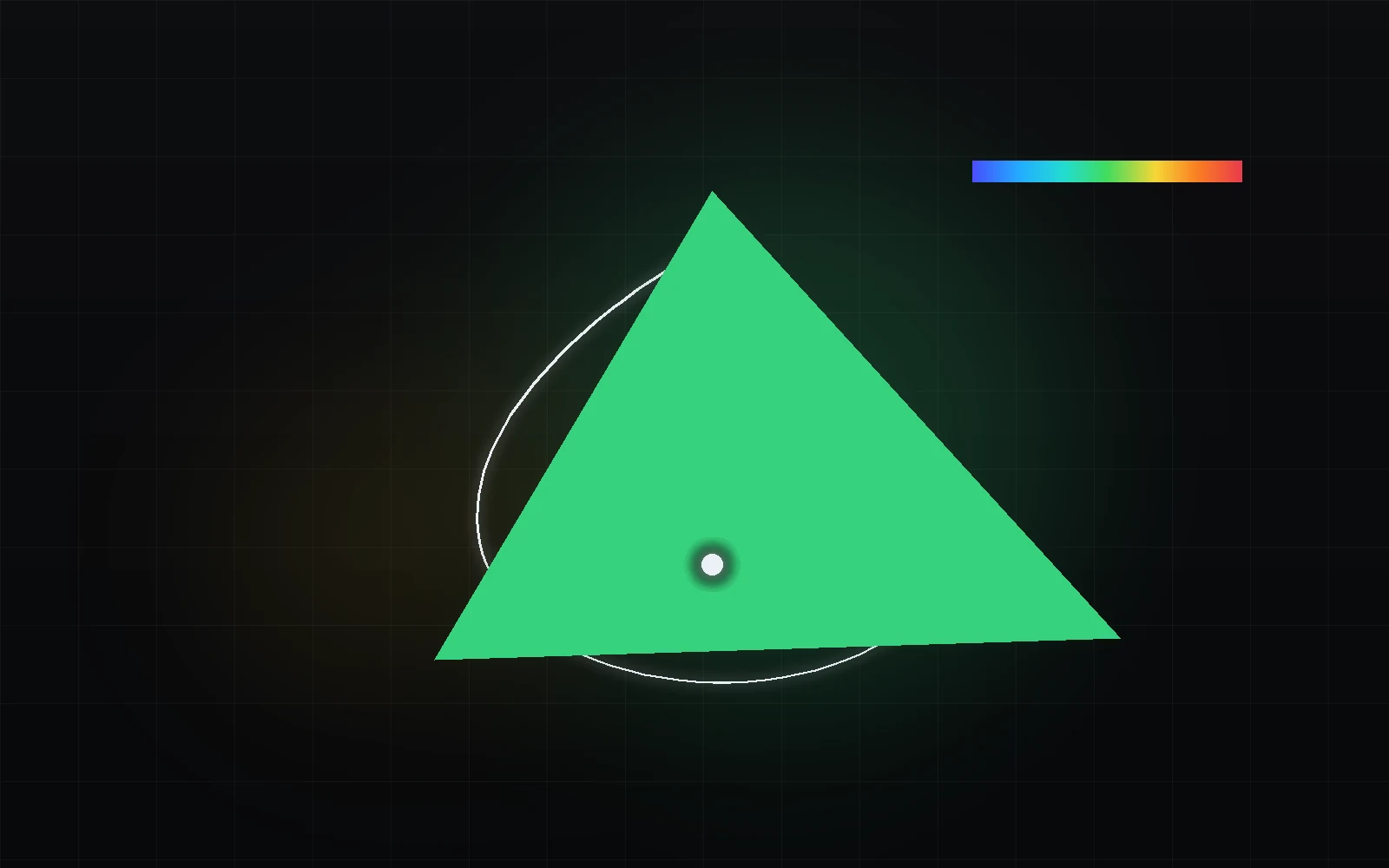 TOPIC ILLUSTRATION
THE ESSENTIAL IDEA
Rec.2020 / BT.2020
BT.2020 defines UHD parameters and wide colorimetry. It neither forces use of the whole gamut nor replaces HDR transfer functions, target luminance or display capability.
- Separate BT.2020 from BT.2100 HDR systems.
- Inspect loss when clipping to 0…1.
- Distinguish coordinate container from actual image colours.
Why HDTV Rec.709 was not enough for UHD
BT.2020 describes a UHD system for production and international exchange. It covers wider primaries as well as picture dimensions, frame rates, signal structure and quantization.
This chapter uses BT.2020-2. For grading, distinguish the system from one of its components: RGB gamut. UHD resolution does not automatically imply BT.2020, and selecting BT.2020 does not automatically make a file HDR.
What this means in practice
Resolution, colour space and HDR transfer belong on separate lines in a delivery brief.
BT.2020 primaries: why the triangle is so large
BT.2020 primaries are R (0.708, 0.292), G (0.170, 0.797), B (0.131, 0.046), with D65 white. This basis differs from P3 and Rec.709, so identical linear RGB generally produces different XYZ.
The laboratory converts a Rec.2020 colour through XYZ into Rec.709 or P3. It retains negative components and values above one: these indicate that the bounded destination RGB model cannot reproduce the stimulus unchanged.
What this means in practice
With saturated green, a negative destination red is not a rounding error or an instruction to clamp source data immediately.
Why the white point stayed D65
Rec.709, Display P3 and BT.2020 share reference D65. A purely colorimetric conversion between their linear coordinates with matching normalization needs no separate white adaptation, but it does need an RGB basis change.
Decode transfer encoding before applying the matrix and encode afterwards as required. Gamut conversion, transfer conversion and white adaptation are different steps even when an application combines them in one control.
What this means in practice
Equal-channel linear grey remains grey; saturated colours generally acquire different RGB numbers.
Rec.2020 is not HDR
BT.2020-2 includes its own relative transfer characteristic. HDR television is addressed by BT.2100, which uses PQ and HLG with wide primaries. These are not two names for the same specification.
A primary tag alone cannot tell you whether the signal is SDR, PQ or HLG. Correct interpretation also requires transfer, levels and signal-representation information. Changing gamut cannot add dynamic range to the source.
What this means in practice
For HDR output, check the PQ/HLG system and monitoring conditions as well as Rec.2020.
The BT.2020 OETF: a familiar piecewise form with more precise constants
The relative OETF has a 4.5E linear branch and an αE^0.45 − (α − 1) branch. BT.2020 Table 4 gives smooth-join conditions and practical rounded constants: α = 1.099, β = 0.018 for 10 bits; α = 1.0993, β = 0.0181 for 12 bits.
Do not confuse this function with PQ or HLG. Do not silently substitute constants from another document either: slightly different rounding can affect numerical tests near the breakpoint even when curves look similar.
What this means in practice
In a mathematical report, state whether the smooth-join solution or a published rounded variant is used.
Why BT.2020 is designed around 10 and 12 bits
BT.2020 specifies 10- and 12-bit component coding. Bit depth determines the available digital steps; primaries determine the basis in which those steps are interpreted.
Higher precision helps gradients and transforms, but does not expand gamut by itself. Converting an already damaged 8-bit gradient to 10 bits cannot recover missing original values. The stage at which rounding occurred also matters.
What this means in practice
Check a gradient after the final codec: a high-precision timeline does not guarantee equal delivery precision.
Nominal video levels in 10 and 12 bits
Nominal 10-bit RGB/Y′ black and white are 64 and 940; for 12 bits they are 256 and 3760. Neutral chroma codes are 512 and 2048 respectively; chroma bounds are considered separately.
Range maps normalized quantities to integers. It does not change primary coordinates. Do not stretch levels by appearance when the problem is the decoder’s incorrect range interpretation.
What this means in practice
The same neutral ramp has different integers at 10 and 12 bits while retaining the same normalized meaning.
Y′ coefficients changed with the primaries
For conventional nonlinear BT.2020 component coding, luma is Y′ = 0.2627R′ + 0.6780G′ + 0.0593B′. These are not the Rec.709 coefficients. The matrix must match the chosen signal representation.
An incorrect matrix may be less evident on neutral ramps than on saturated colours. Test both grey and coloured samples. Adjusting Saturation in a grade cannot systematically repair incorrect matrix interpretation.
What this means in practice
Correct primary tags with an incorrect matrix do not guarantee correct colours.
Why BT.2020 has constant-luminance and non-constant-luminance YCbCr
BT.2020 defines conventional non-constant-luminance and separate constant-luminance variants. The former derives luma from already nonlinear RGB; the latter treats linear luminance before its corresponding encoding.
The branches cannot be exchanged by renaming YCbCr. Establish which variant the encoder produced and the decoder supports. BT.2020 without matrix information leaves that unresolved. This chapter’s lab uses linear RGB and does not simulate a component codec.
What this means in practice
Record matrix coefficients alongside primaries and transfer when handing off a test file.
4:4:4, 4:2:2 and 4:2:0 do not change the Rec.2020 gamut
Chroma subsampling describes the spatial grid of colour-difference samples. 4:2:0 and 4:2:2 are not gamut names. Bit depth, sampling structure and colorimetry answer different questions.
Check fine coloured graphics and edges for reduced chroma resolution, saturated colours for gamut limits, and smooth gradients for quantization. A single face shot cannot replace these distinct tests.
What this means in practice
“10-bit 4:2:0 BT.2020” contains three separate properties, not one quality score.
Rec.2020 as a container: why content may actually be P3
A signal coordinate space may exceed the colours actually used. Material limited to P3 during mastering can be carried in a BT.2020 representation. That is not a reason to stretch saturation to every vertex of the larger triangle.
The lab first calculates a coordinate conversion, then separately shows hard clipping of destination RGB to 0…1. Its post-clipping XYZ difference is a numerical model error, not perceptual ΔE. Production gamut mapping may behave differently and needs separate evaluation.
What this means in practice
Compare the original and clipped points: forcing numbers into range can change the stimulus itself.
Why 'accepts Rec.2020' does not mean 'displays all of Rec.2020'
Accepting a file and physically reproducing every encoded chromaticity are different capabilities. A display may correctly recognize BT.2020 and map it into a narrower panel gamut.
A two-dimensional diagram omits luminance-dependent limits of saturated colours. Neither input compatibility nor one coverage percentage verifies an entire HDR result. The browser preview is also limited to its stated sRGB path and does not measure your display.
What this means in practice
Do not judge preservation of a wide signal solely from two equally clipped swatches.
How to think about Rec.2020 in CST/RCM
Define input and output with gamut, transfer, image state, range and format. In managed projects, establish where technical transforms already occur.
For a narrower Rec.709 output, choose appropriate tone and gamut rendering, then inspect saturated objects and highlights in motion. Do not merely change an export tag to Rec.709 after working in BT.2020. Metadata describes a result; it does not perform missing processing.
What this means in practice
A control delivery should expose the expected difference between a converted file and a merely retagged file.
A MODEL YOU CAN CHECK
A large gamut does not answer every question.
Keep the meaning, the calculation and the limitation together.
RGB_target = M_target⁻¹ × M_2020 × RGB_2020Linear conversion between D65 bases preserves XYZ. Clipping target RGB is a separate irreversible operation. The displayed max |ΔXYZ| is not perceptual ΔE.
| Concept | What it describes | What not to conclude |
|---|---|---|
| BT.2020 | UHD parameters, primaries and signal. | Not an automatic HDR declaration. |
| BT.2100 | HDR systems with PQ/HLG and related parameters. | Not a promise about a particular panel gamut. |
| RGB outside 0…1 | A conversion result outside the destination’s bounded range. | Not a reason to blindly clip intermediate data. |
| Clipping / gamut mapping | Hard limiting / a broader rendering strategy. | No guaranteed preservation of XYZ or hue. |
DO. OBSERVE. EXPLAIN.
Locate the moment colour is lost.
Begin with neutral in the lab, then move gradually towards Rec.2020 green.
- 01
Neutral input
Set colour amount to 0 and choose Rec.709. Record all three destination components and post-clipping error.
CHECKNeutral converts within range; clipping introduces no meaningful XYZ error.
- 02
Colour beyond the target
Raise the green amount until destination RGB becomes negative. Note when the target range is exceeded.
CHECKOriginal coordinates remain available before clipping.
- 03
Separate limiting
Compare the clipped point and XYZ error; repeat for P3.
CHECKThe stimulus changes, not just the numeric range.
- 04
Project output
In a project copy, inspect chosen gamut rendering on saturated objects and gradients.
CHECKYou distinguish deliberate rendering from incorrect metadata.
Check your understanding
TEST THE EXPLANATION
A situation, not a trick question.
Answer first. Open the reasoning afterwards.
01Does Rec.2020 necessarily mean HDR?+
No. Transfer characteristics and the complete signal context are required; primaries alone are insufficient.
02The two previews look identical, but XYZ differs.+
Both may clip into sRGB for display. A clipped preview cannot prove that wide source coordinates are identical.
03Did Rec.709 → Rec.2020 create new colours?+
A correct noncreative conversion preserves stimuli. The wider basis can represent them but does not recover absent information.
Avoid these shortcuts
- Equating file extension or UHD with HDR.
- Using a Rec.709 matrix for all BT.2020 YCbCr.
- Stretching saturation merely to fill the triangle.
From the model to your workflow.
In production, identify the source, transform placement and required output separately. The lab verifies a bounded mathematical model; it does not measure your display, replace project settings or certify an exported file.
CHECK THE FOUNDATION
Sources and model limits.
Editorial review: 1 October 2026. Links identify the definitions and formulas; exercises are independent teaching examples.
- [1]ITU-R · BT.709-6 (2015) ↗
HDTV parameters: primaries, source OETF, component signals and digital levels. Tables 1 and 3 checked in the PDF.
- [5]ICC · Display P3 ↗
P3, D65 and the sRGB transfer: a distinct definition, not DCI-P3.
- [8]ITU-R · BT.2020-2 (2015) ↗
Tables 3–5: UHD colorimetry, OETF, component-signal variants and quantization.
- [9]ITU-R · BT.2100-3 (2025) ↗
HDR television parameters. PQ/HLG are not implied by the BT.2020 gamut label alone.
- [10]W3C · CSS Color 4 ↗
Candidate Recommendation Draft, 30 September 2026: explicit CSS spaces, interpolation and gamut mapping. A work in progress.
- [17]Academy · ACES 2 Output Transform ↗
Rendering Transform and Display Encoding; JMh, tone and colour compression. The lab does not implement this Output Transform.
- [21]Blackmagic Design · Color ↗
Color and colour-management context. Setting names and locations depend on Resolve version and configuration; live projects were not tested here.
- [22]ITU-T · H.273 (2024) ↗
Identification of video primaries, transfer characteristics and matrix coefficients.